
America's Bastards
From allied western leaders to aid recipients in Africa, America has left its children in the lurch.

Karl Polanyi, famous economic historian and social theorist, began his seminal work, The Great Transformation: The Political and Economic Origins of our Time (1944) with the following pair of engaging sentences:
“Nineteenth-century civilisation has collapsed. This book is concerned with the political and economic origins of this event, as well as with the great transformation which it ushered in.”1
Reading these words in 2026 produces a strange double-desire for the reader: first, to read on and see what Polanyi has to say about the closing out of his own age and of onset of our own; but second, – and perhaps even more vital – to put the book down and think about the analogous transformation that is overtaking us now. One reads on with our present – and future – constantly in the back of their mind.
Indeed, twentieth-century ‘civilisation’ has collapsed.
What follows is not a book about the political and economic origins of this collapse, but only a few remarks about the great transformations that seem to be in store for us.
When did the twentieth-century world collapse?
Francis Fukuyama famously pronounced the “end of history” with the collapse of the Soviet Union at the start of the 1990s. Later on, Timothy Garton Ash added to this thesis – along with countless analysts and academics – that 9/11 was the true beginning of the 21st century.
In my telling, the 20th century did not come to an end with the collapse of the Soviet Union and the resolution of the Cold War. That pivotal moment might have dramatically changed the complexion of our world, but it did little to disrupt the basis of American imperialism; if anything, it seemed to confirm American supremacy. The Cold War mentality persisted, merely changing its orientation toward Islam and a new cast of characters from the Middle East (Saddam, Gaddafi, Khameini, etc.).
Besides, how else can we account for the nearly two decades of uninterrupted American ‘intervention’ in the Middle East after 9/11? Two endless wars that ravaged two nations, all going on in the frictionless space of American fossil-fuelled militarism. The world simply stood and watched while America reinstated its authority on the essentially passive, oil-rich lands of the Middle East.
— Meanwhile, everyone was still trying their best to believe in the global, rules-based order that the American century cooked up and crammed into its children’s mouths. And this is important, because what has been more significant since the second world war than American global dominance was American ideological democracy and its humanitarian hegemony.
For all its cynical misuse and ill intent, the fact remained for nearly 80 years that America – and the west more generally – propagated a civilisation of more-or-less open migration, post-Soviet democratization, as well as a global system of humanitarian relief which supported countless people across the globe —even while many of these people suffered at the hands of American imperialism. (Nothing exemplifies this point more starkly than Middle Easterners with American passports living under American bombs from Baghdad to Beirut!)
All of this remained intact for the first two decades of the 21st century, though migration ebbed and flowed after 9/11. This, to me, is the essence of 20th century civilisation: America as super-nanny of the world, funding the UN, sponsoring economic growth the world-over, all while simultaneously imposing its will and hegemony over the breadth of the earth. It is with the sudden collapse of this ‘soft power’ mixed with overt hard military power that truly heralds the start of the 21st c.
So when did twentieth-century civilisation finally collapse? It can be answered with a single word: Gaza.
To be sure, America never did anything to ease the plight of the Palestinians before the onset of the genocide in 2023; it always served as Israel’s guarantor for its project of colonial settlement and brutal apartheid on the occupied Palestinian territory. But nothing in the history of America’s support for Israel is matched by what we have seen over the last few years. From the uninterrupted flow of weaponry to the blanket political cover for its genocide, from the west’s sheerest disregard for even the pretence of international law to its open pursuit of further wars that may or may not be in Israel’s interest—nothing in the past even compares to the world revealed by Gaza.
It seems clearer now than ever before that America is finally cutting the chord, that after decades and decades of cynically nurturing the formerly colonised world’s dependence on American aid, after impeding genuine development everywhere as a means of spreading its ‘soft power’ across the globe, and after bringing the entire world’s climate and ecology to a cliff’s edge — after all this: it now wants to slough off the burden, to cast million and millions into the unknown, to let them all waste away from hunger and disease, drought and raging warfare. For America now sees room enough on this planet only for itself and its pearl necklace of military bases strung around the globe (and Israel is but the largest pearl therein).
Fascist redux in Munich
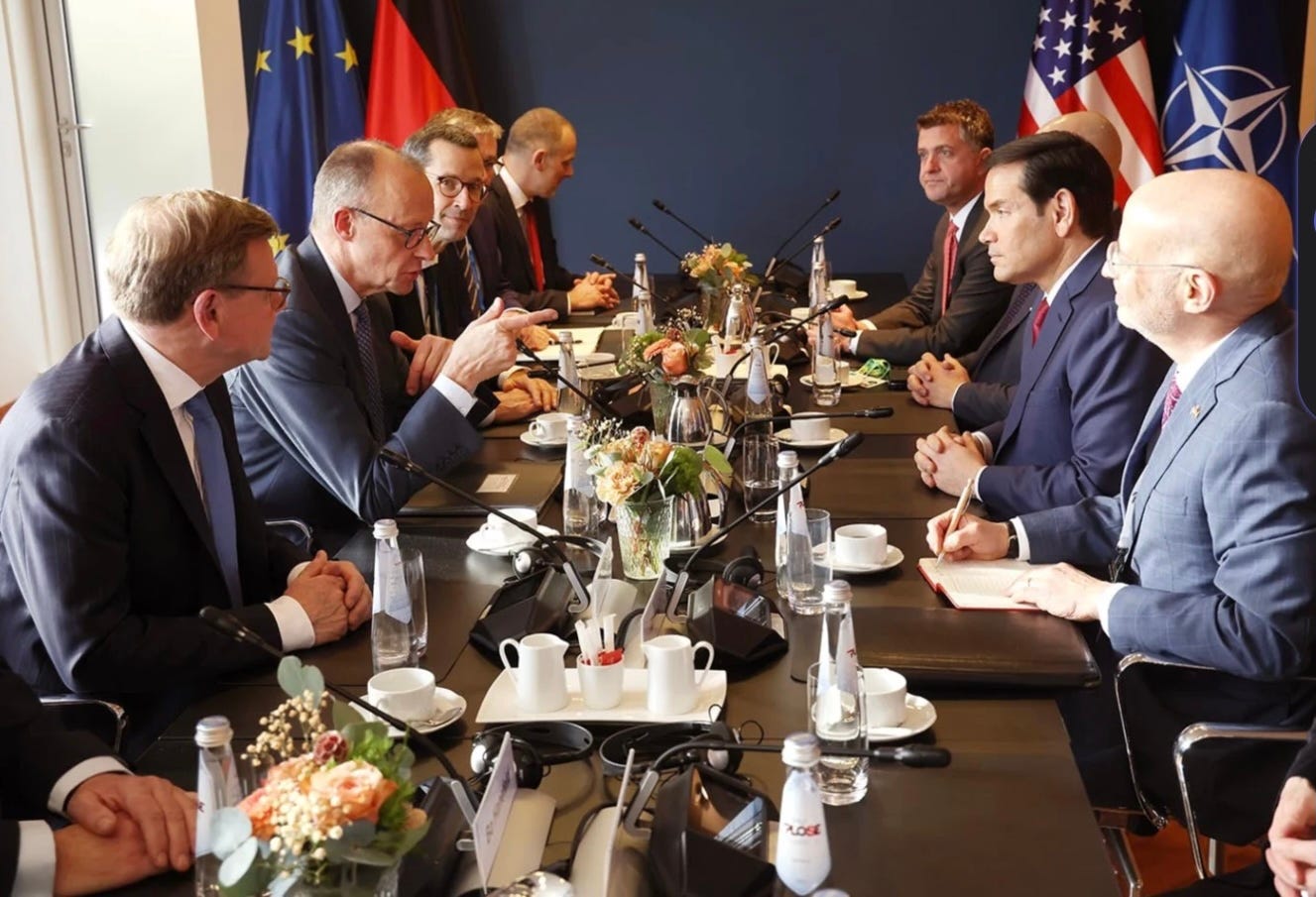
Last month it was Canadian Prime Minister Carney at Davos, this month it is German Chancellor Merz at the 62nd Munich Security Conference. Hailed by liberal analysts as powerful words that stand up to American bullying, a much needed corrective to the "craziness” of our times, these speeches are better understood as part of a growing global chorus for ethnic-statist sovereignty.
If America is no longer super-nanny of the world, then middle powers such as France, Germany, Britain, Canada, and Australia are to take up the task of their own sovereignty. Hence western countries everywhere building up their militaries and their borders. The neoliberal order has truly ruptured, but Carney, Macron, and Merz are not trying to save its dubious merits; rather, they are rising to Trump’s challenge of ethno-statism, salvaging their seats at the newly arising table.
Analysts have contrasted Rubio’s speech in Munich with JD Vance’s last year, calling Rubio’s words more conciliatory than Vance’s last year’s. In truth, it was merely politer, for Europe was already won over to Trump’s outlook; underneath the politer rhetoric still seethes the white supremacist, anti-immigration of Vance’s speech from last year, a vision that seeks to proudly tout white culture and Christian heritage as superior to the rest of the world. All that has changed on the continent is that Europe has fallen in line since between these two speeches.
In truth, Trump’s bullying has not woken Europe and the west up to any moral destiny, but it has nudged them to double down on their ethnic homogeneity and their national sovereignty. It is no coincidence that these leaders all sat back while a genocide unfolded in Gaza; in time they will be committing their own atrocities, that is, imposing ethno-statist sovereignty in a world that has “taken down the side” (to throw Carney’s usage back at him) from its windows.
A note on MAGA historiography
Perhaps the most notable part of Rubio’s speech came at the very start when he talked about the collapse of the Soviet union and the liberal euphoria that followed:
“But the euphoria of this triumph led us to a dangerous delusion that we had entered the ‘end of history,’ that every nation would now be a liberal democracy. That the ties formed by trade and commerce alone would now replace nationhood. That the rules-based global order, an overused term, would now replace the national interest. And that we would now live in a world without borders where everyone became a citizen of the world. This was a foolish idea that ignored both human nature and it ignored the lessons of over 5,000 years of recorded human history.”
I have bolded the words nationhood and human nature in the above passage because they so clearly articulate the ethno-statist logic of the Trump regime, a logic that it has imposed on its allies — that is, if they want to be continue to be its allies. It is important to see how the MAGA line is able to point out an obvious problem – in this case the supposed end of history and the persistence of America has super-nanny – but goes on to draw a wildly illogical conclusion, namely, that America needs to turn back the clock and reimpose its white supremacist DNA.
The MAGA vision of history is one in which Americans are essentially the victims. While it was forced to feed and protect the world, its enemies and rivals had taken advantage of this situation by growing stronger over the last 30 years. This gaslighting is essentially what got Trump into office, but it is important to realise that the current transformations of our age are not all Trump’s doing. No, Trump is more a symptom than a cause.
Remembering the Kyoto Protocol
I will discuss climate change more closely next week, but if someone asked me to pinpoint a specific point in time in which the American century truly began to unravel, I would take us back to the 1997 Kyoto Protocol, in which America essentially made climate mitigation “optional” for powerful countries. This happened under Clinton, at a time when the rules-based order seemed to be at its peak. But alongside the sham Oslo accords and many other hypocritical policies and decisions that articulated the 2000s and 2010s, the decision to ultimately make climate change – an issues that was directly caused by American industry and imperialism and that threatened to economically and politically destabilise the world – a matter of preference; that, to me, was the start of the current unravelling we are living through today.
Polanyi, Karl, The Great Transformation (Penguin Modern Classics, 2024); p.3.
Very insightful!
Good article!